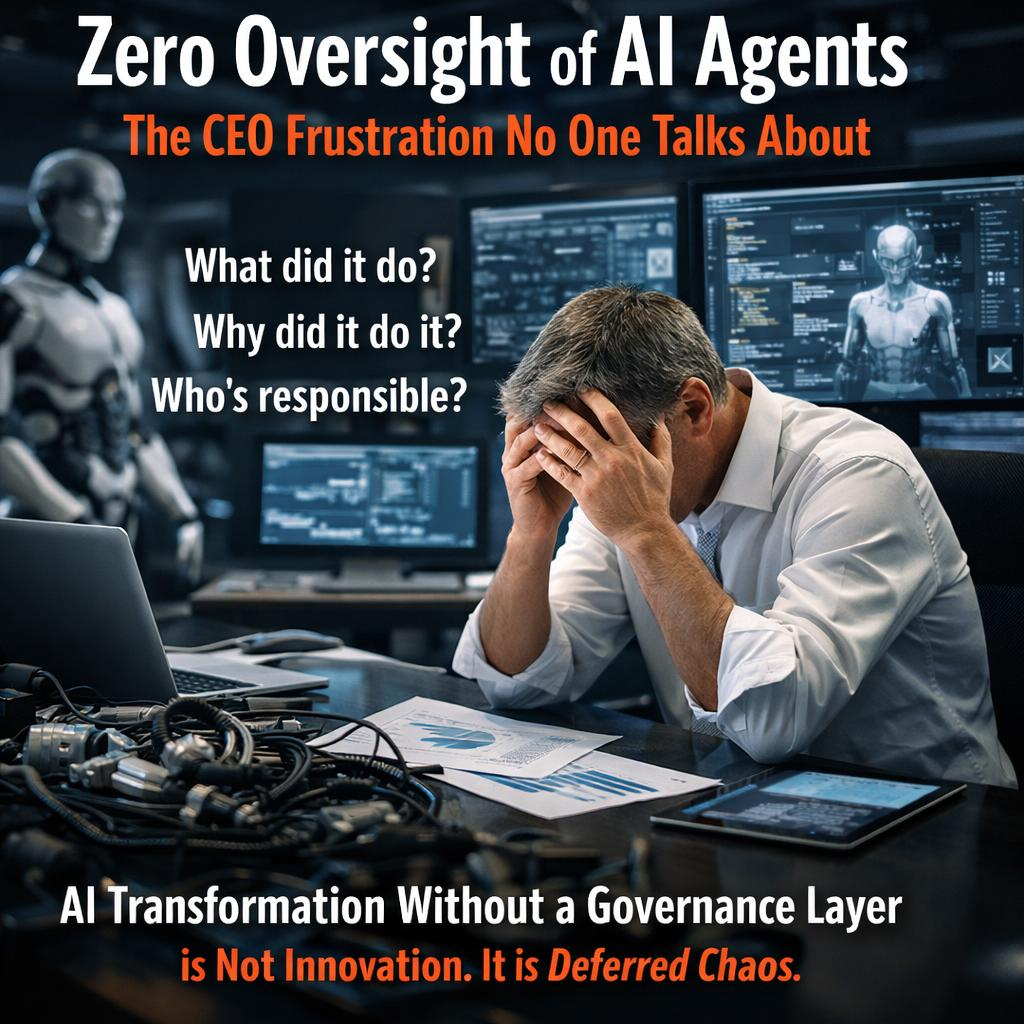
Even a world-class infrastructure company had difficulty answering what exactly the system did, why it did it, and who was responsible.
AI transformation is accelerating inside companies at a pace few CEOs have truly internalized.
Every department is deploying AI agents.
Every function is automating decisions.
Every team is optimizing locally.
And yet, a quiet and deeply uncomfortable realization is spreading at the executive level:
There is effectively zero centralized oversight of AI agents.
Not by design.
Not by policy.
Not by accountability.
This Is Not Innovation. It’s Deferred Chaos.
Let’s be precise.
AI transformation without a governance layer is not innovation.
It is deferred chaos.
You are accumulating a new class of technical debt — not static, not dormant, but autonomous.
This debt:
- Acts on its own
- Makes decisions at machine speed
- Chains actions across systems
- Operates outside traditional controls
And unlike classic technical debt, this one doesn’t just slow delivery.
It escalates into existential risk.
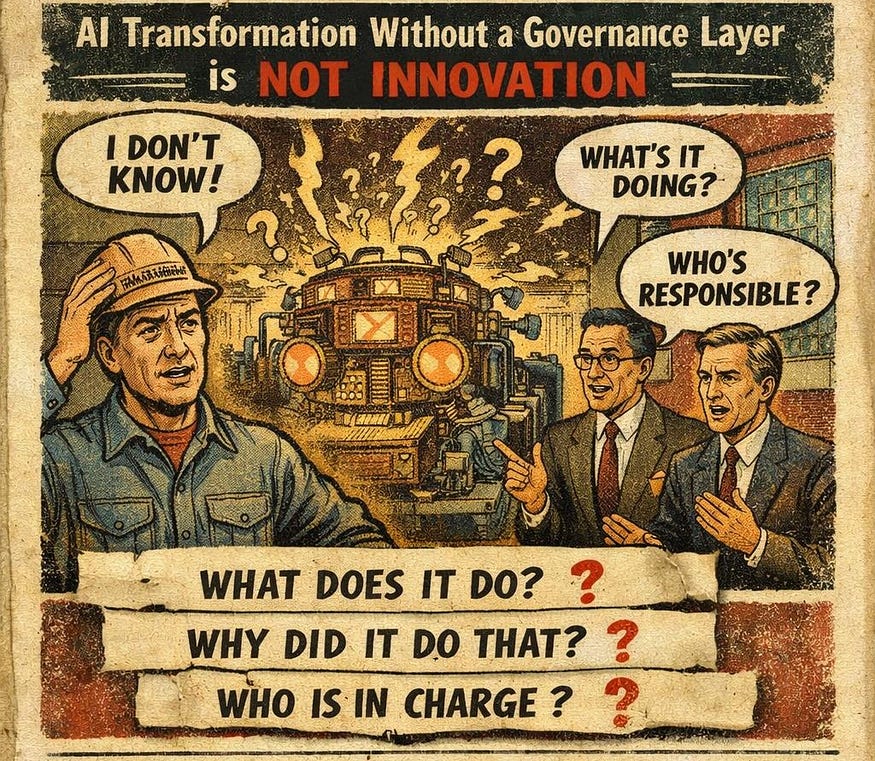
This Is No Longer Hypothetical
We no longer need to speculate about what can go wrong.
A few months ago, Cloudflare publicly struggled to identify the root cause of a major outage, which was ultimately traced back to an autonomous system behaving in an unexpected way.
The most important detail was not the technical failure.
It was the organizational one:
Even a world-class infrastructure company had difficulty answering
what exactly the system did, why it did it, and who was responsible.
That is the future every company is walking toward.
And Cloudflare is not alone.
Across industries we are already seeing:
- AI-driven cost explosions caused by runaway automation
- Cascading failures triggered by agents interacting in unforeseen ways
- Sensitive data unintentionally exposed through external AI APIs
- Production systems altered or deleted without a clear human action to trace back
These are not edge cases. They are early warning signals.
Why This Becomes Existential for the CEO
When — not if — a serious AI-driven incident happens, the organization will be forced to ask one single, devastating question:
Who allowed this agent to exist and act with that level of power?
If you have not built a formal governance layer, the answer will be painfully honest:
Everyone was involved.
And therefore, no one was responsible.
That is the moment where:
- Trust erodes
- Boards lose confidence
- Regulators lean in
- And the CEO inherits a crisis they never knowingly approved
This is not a technology failure. It is a leadership and governance failure.
The Illusion of Control
Most CEOs assume this is handled somewhere.
- “Security must be reviewing it.”
- “IT surely has guardrails.”
- “AI teams are being careful.”
In reality:
- Agents go live without formal approval
- Permissions expand silently over time
- Agent-to-agent communication is uncontrolled
- Costs are discovered after invoices arrive
- No one monitors agent behavior in real time
What exists today in most companies is not AI governance. It is optimism by default.
The Missing Layer: Sentinels
The answer is not to slow AI adoption.
The answer is to govern AI by design.
That requires a new operating layer built specifically for autonomous systems.
Layer One: Human Sentinels (Accountability)
A human sentinel is a named, accountable authority.
Their job is not to micromanage AI — it is to authorize its existence.
They are responsible for:
- Approving an agent before it goes live
- Defining its scope of action
- Setting non-negotiable permission boundaries
- Assigning a risk classification to every agent
This role is absolutely vital. But it is not sufficient on its own.
Why Human Oversight Alone Will Fail
AI systems move faster than humans can reason.
Human sentinels define policy, not continuous enforcement.
They decide:
- What is allowed
- What is forbidden
- What level of risk is acceptable
But they cannot:
- Observe millions of agent actions in real time
- Detect subtle behavioral drift
- React instantly when thresholds are crossed
Human oversight inevitably becomes the bottleneck. And this is where most organizations stop — dangerously.
Layer Two: Agent Sentinels (Governance by Design)
This second layer is essential.
Agents watching agents.
Agent sentinels are meta-agents whose only purpose is governance.
They do not innovate.
They do not optimize business KPIs.
They enforce rules automatically and relentlessly.
Their responsibilities are precise:
- Monitor behavioral drift before incidents occur
- Enforce policy regardless of prompt manipulation
- Block forbidden API communication — always
- Track cost, data, and risk thresholds continuously
And critically:
They have the authority to automatically kill or quarantine agents.
No meetings.
No escalation delays.
No human hesitation.
When a boundary is crossed, action is immediate.
CEO Conclusion: Start the Sentinel Process Now
Not next quarter.
Not after the first incident.
Not after regulators ask uncomfortable questions.
Every CEO may mandate, immediately:
- A formal Sentinel Process for all AI agents
- Named human accountability for agent approval
- Automated agent sentinels with kill authority
- A registry of every agent and its permissions
- Clear executive visibility into AI risk exposure
AI transformation without this layer is not bold.
The companies that survive the AI era will not be the fastest adopters.
They will be the ones who can answer — calmly and confidently:
We know exactly which agents exist,
who approved them,
what they are allowed to do,
and what stops them when they go too far.
Comments are closed