The Serial Processor in a Parallel World: Why Focus is Becoming Our Biggest Vulnerability
There is a palpable anxiety vibrating through the glass towers of the white-collar world. For decades, the path to success was clear: pick a lane, narrow your focus, become an expert. We were taught from childhood that sustained attention on a single task was the ultimate virtue, the key to mastery. We proudly called ourselves specialists.
But the ground rules of intelligence have shifted abruptly. We are entering an era defined by artificial intelligence and advanced robotics—entities that operate on fundamentally different architectural principles than the human mind.
The existential crisis facing the modern knowledge worker isn’t just that machines are faster. It’s that they possess a structural advantage we physically cannot replicate: true multi-processing.
The Illusion of Human Multitasking
To understand the threat, we must first understand our own limitations. Humans love to claim they are excellent multitaskers. Neuroscience, however, tells a humbling story.
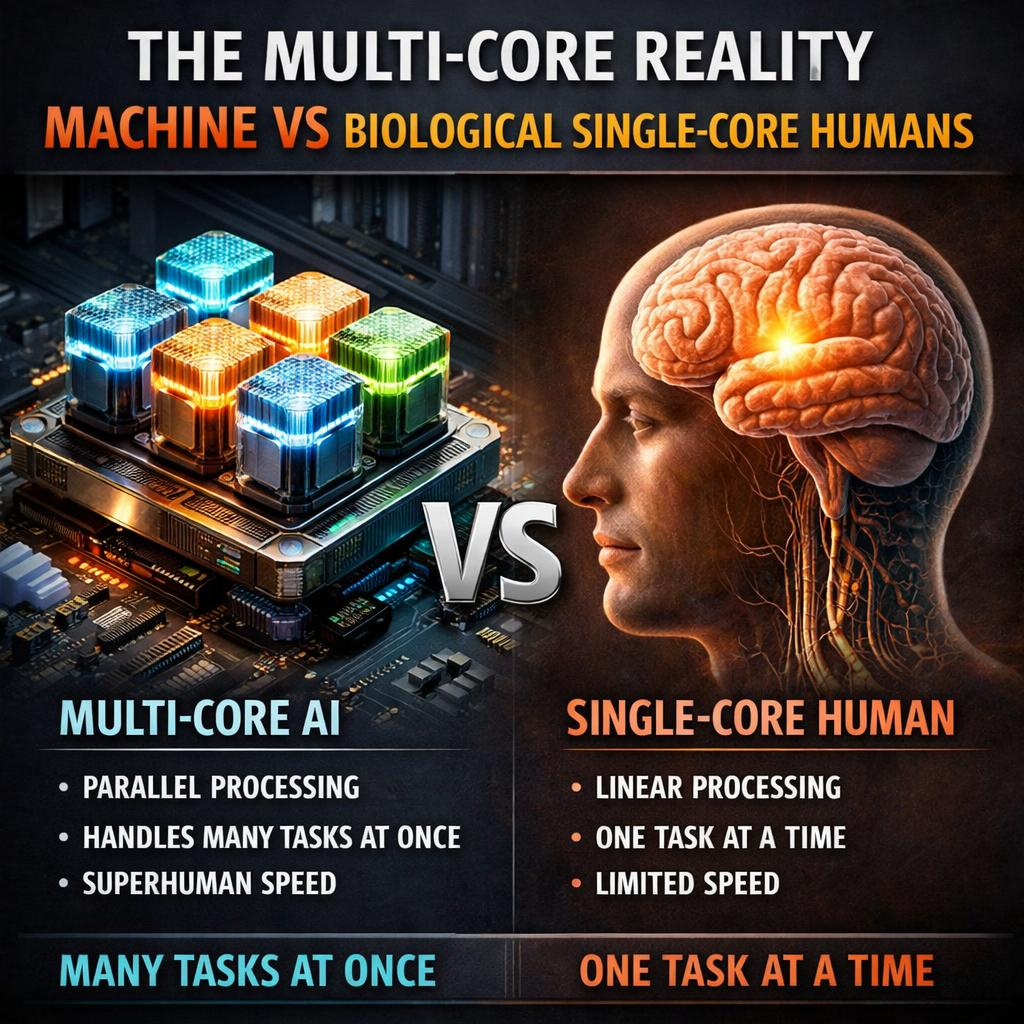
When you think you are multitasking—answering emails while drafting a report and half-listening to a conference call—you are not actually doing these things simultaneously. Your brain is rapid-task-switching. It is serial processing, actively disengaging neural resources from one task to apply them to another, over and over again. Every switch incurs a “cognitive cost,” taxing your energy and degrading the quality of your attention.
We are biological single-core processors. We were evolved to throw a spear at one mammoth, to nurture one child, to focus on one spreadsheet cell. Our entire educational system and professional hierarchy have been built to optimize this single-core focus. We reward the deepest diver, the most myopic specialist.
The Multi-Core Reality of the Machine
Enter the robot and the AI agent. They are not bound by biological limitations.
A modern AI system running on powerful GPUs (Graphics Processing Units) or TPUs (Tensor Processing Units) does not utilize a single “brain.” It utilizes thousands of computing cores working in concert. They possess true parallel processing capabilities.
An advanced AI doesn’t just switch rapidly between analyzing financial data, parsing legal text, and writing code; it can do them literally at the same time, with dedicated resources for each, without losing focus or experiencing fatigue. A robotic system doesn’t just move an arm; one “CPU” manages balance, another processes visual data, a third calculates grip strength, and a fourth interfaces with the central network—simultaneously.
While the human specialist is sleeping, the AI is running millions of parallel simulations to optimize a supply chain. The human advantage of “deep focus” is being outpaced by the machine advantage of “broad, simultaneous, relentless execution.”
The Vulnerability Trap
This architectural difference is why the old advice for white-collar survival is suddenly dangerous.
If your career value is tied to your ability to focus intensely on a specific, repeatable cognitive task—calculating actuarial tables, diagnosing routine radiology scans, drafting standard contracts—you are in the crosshairs.
By training ourselves to be hyper-specialized single-taskers, we have effectively trained ourselves to be easily automated. We made our jobs “CPU-friendly.” An AI does not need ten years of schooling to learn that specialty; it ingests the entire corpus of knowledge in that field over a weekend and then applies it using multi-core processing power that dwarfs human capability.
The single-minded focus that was once our greatest asset has become our most significant vulnerability. We built silos of expertise, and AI is flooding them all at once.
Rethinking the “Human Operating System”
If we cannot compete on processing architecture, how do we survive?
The answer lies in leaning into the areas where parallel processing fails. Machines are incredible at execution within defined parameters. They are less adept at navigating ambiguity, defining the parameters themselves, and understanding the chaotic emotional undercurrents of human organizations.
We must shift our mental models away from being “processors” of information and toward become “integrators” of intelligence.
1. From Deep Focus to Agile Synthesis: Instead of just focusing on one narrow task, the valuable human of the future must be able to zoom out. We need the cognitive agility to look across multiple domains—connecting the dots between what the marketing AI is saying, what the engineering robotics team is building, and what the legal bots are flagging. The human becomes the connective tissue between disparate, highly specialized AI systems.
2. Cultivating “Human Multitasking” (The Real Kind): While we can’t cognitively process two math problems at once, humans can process different types of inputs simultaneously. We can read a room’s emotional temperature while listening to technical data. We can weigh an ethical implication while analyzing a financial projection. This is cross-modal processing, and it is currently the frontier that AI struggles to cross.
3. Valuing Judgment over Calculation: In a world of unlimited processing power, the answer is cheap. The question is expensive. The ability to frame the right problem, to decide which mountain the AI should climb, and to judge whether the outcome is morally deemed “success”—that remains a uniquely human province.
The Wake-Up Call
The era of the single-task specialist as the pinnacle of white-collar achievement is drawing to a close. We cannot out-focus a machine that never blinks, and we cannot out-process a system with ten thousand cores.
The challenge now is not to become more robot-like in our efficiency. It is to recognize the limitations of our own “serial hardware” and stop trying to compete in a game we are biologically destined to lose. Instead, we must build a new game—one where generalism, adaptability, and human synthesis (or anything else..) are the prize-winning attributes.
Comments are closed