The Next World Order Will Be Built by AI Agents — Not Human Population
The 21st-century economic landscape is undergoing a seismic shift: productivity and strategic advantage are no longer primarily tied to human population growth or traditional industrial output — but to AI agents, automation, and sovereign digital capabilities.
At Ikarus Career, we believe the nations that master the development, deployment, and governance of AI agents will be the ones who define global wealth, influence, and competitiveness in the decades ahead. This transformation isn’t theoretical — it’s already underway.
AI & Automation: Productivity Gains That Reshape Economies
AI isn’t just a tool — it’s a growth engine.
🔹 Trillions in Economic Value
Economists at McKinsey estimate generative AI alone could add between $2.6 trillion and $4.4 trillion annually to the global economy, boosting labor productivity growth by up to 0.6% per year through 2040. Foreign Affairs Forum
🔹 Broad GDP Uplift
Across regions, AI’s impact varies — e.g., China’s economy could see ~26% GDP uplift by 2040; North America ~14.5%; Europe ~11.5%; Latin America ~5.4%.
These projections mean AI’s impact far outweighs most technologies introduced over the past half-century.
🔹 Manufacturing Productivity Jump
In core sectors like manufacturing — one of the most automation-ready industries — AI applications (predictive maintenance, optimization analytics, robotics) could drive ~25% increases in productivity by 2035. Reddit
🔹 National Productivity Gains
Even smaller economies are beginning to quantify gains. Romania’s GenAI adoption, for example, could deliver €1 billion in public sector productivity annually and contribute meaningfully to GDP growth. McKinsey & Company
Countries Already Betting on AI Leadership
Global Leaders
According to the 2025 AI Index Report, major nations are committing significant resources to secure an AI future:
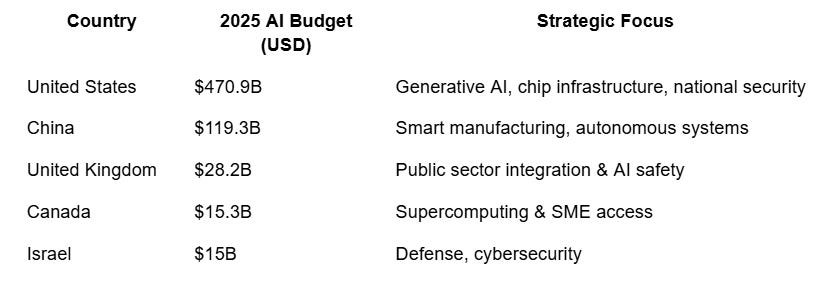
These investments span both R&D and industrial deployment, underscoring national strategy as a key lever of future competitiveness.
Small Nations With Big AI Potential
Large economies aren’t the only ones investing — smaller and emerging nations are pursuing AI strategically too, often outpacing larger counterparts in adoption intensity:
🇸🇪 Sweden
AI is projected to account for 0.63% of Sweden’s GDP by 2025, the highest ratio in Europe, while usage grows rapidly across sectors. TechRound
🇭🇷 Croatia & 🇬🇷 Greece
Despite smaller economies, both countries are doubling down on AI adoption, with usage growth rates exceeding 50–150%. TechRound
🇪🇪 Estonia
In a commissioned report, generative AI could contribute up to 8% of Estonia’s GDP annually if widely adopted — a stunning potential impact for a small digital nation. Reddit
National AI Strategies: Blueprint for Global Influence
Many nations have formal AI strategies:
- United Arab Emirates aims to make AI a core part of its GDP, investing in infrastructure, services, and regional expansion projects like “AI for Development.”
- Saudi Arabia is embedding AI deep into its Vision 2030 economic plan, with hundreds of millions deployed in training, hubs, and venture capital for tech startups.
- European Union countries are allocating significant digital transformation funds to AI projects, with Italy and Spain leading in absolute AI funding under the EU Digital Decade program.
These strategies align with a global pivot: nations are recognizing AI sovereignty and digital capability as strategic assets, just as natural resources once were.
Why AI Agents Trump Population Growth
Traditional economic thinking emphasised labor and population size as engines of growth. Today, intelligent agents and automation systems amplify human cognition — enabling fewer people to produce significantly more output.
Consider this:
- Firms using AI tools report productivity improvements (some surveys suggest >25–80% gains).
- Routine tasks in sectors like consulting, banking, and manufacturing are already being automated — reshaping job roles toward strategy, oversight, and creative problem-solving.
A world where AI agents augment human capability means smaller, digitally-savvy nations can leapfrog traditional industrial leaders by investing in AI talent, infrastructure, and governance — not just in population growth.
The New Strategic Imperative
Nations that excel in deploying and nurturing AI agents and intelligent automation are poised to:
- Amplify productivity and unlock trillion-dollar economic value
- Create new high-skill job categories while reshaping legacy industries
- Expand influence in a digital-first global order
- Close gaps with historically dominant powers
At Ikarus Career, we see this as the defining economic narrative of our time: investing in people not as replaceable labor, but as architects of AI-driven futures. The winners in the coming era will be those who cultivate AI agents, skillful talent, and sovereign digital capacity — not merely biological population.
Comments are closed