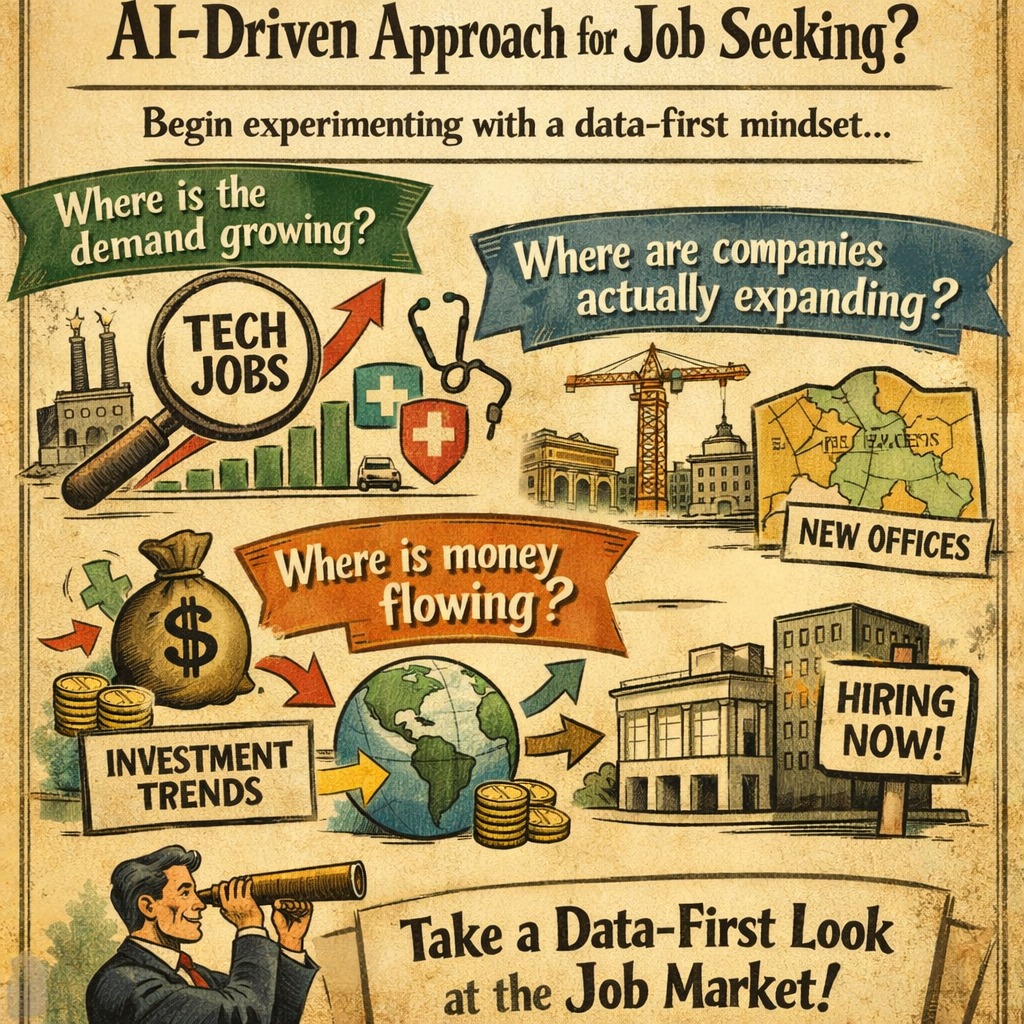
Job hunting usually starts in a very familiar way:
“Looking for a role → search openings → apply.”
This has been the default method for decades.
Pick a title. Search for it. Hope for the best.
But lately, I’ve been questioning whether this still makes sense in a world where job markets are shifting faster than ever — and where AI can process more market signals in minutes than we can in weeks.
So instead of starting with a role-first mindset, I began experimenting with a data-first mindset.
And the shift is surprisingly powerful.
From Role-First to Data-First
The traditional approach assumes something important:
That the role you want already matches where opportunity exists. But what if the smarter starting point isn’t what you want to be, but:
Where is the demand growing?
Where is money flowing?
Where are companies actually expanding?
This is where AI becomes useful — not as a job search bot, but as a career intelligence tool.
Step 1: Aggregate Market Signals with AI
Instead of manually browsing job boards, AI tools can help collect and analyze signals such as:
- Salary data by role, country, and company growth stage
- Job opening velocity and trending skill demand
- Remote vs on-site hiring ratios
- Market capitalization and venture funding trends (to understand who is hiring and expanding)
This shifts the perspective from:
– “Where can I work?”
to
+ “Where is opportunity growing?”
Step 2: Overlay Lifestyle & Mobility Factors
Opportunities are not just about salary anymore — especially if you’re thinking with a digital nomad or globally mobile mindset.
So the next step is layering additional context:
- Salary vs cost of living (nomad-adjusted)
- Remote work allowance and visa flexibility
- Time zone alignment
- Career network density
When combined, these factors reveal something powerful:
A high salary in one country may be less valuable than a moderate salary in another with lower costs and stronger flexibility.
AI can simulate this dynamically and suggest:
Which countries or cities may best match your profile — not just professionally, but practically.
Step 3: Watch the Signals That Matter
Once you stop chasing titles and start following signals, new metrics become more useful:
- Job posting trends
- Recruiter response patterns
- Skill scarcity in specific markets
These signals tell you not just where jobs exist, but:
Where you are most likely to succeed.
A Different Way to Think About Job Seeking
This approach doesn’t replace ambition or personal interest.
It simply adds a layer of intelligence.
Instead of asking:
“What role should I apply for?”
You begin asking:
“Where is demand growing — and how can I position myself within it?”
In a world shaped by remote work, global talent pools, and AI-assisted decision-making, this may be a more realistic way to navigate careers.
Final Thought
Job seeking no longer has to be a guessing game.
With AI, it can become a process of:
Signal → Insight → Positioning
We tried to vibe code the idea as an MVP, to gather this information for us, feel free to try and give feedback.
Comments are closed