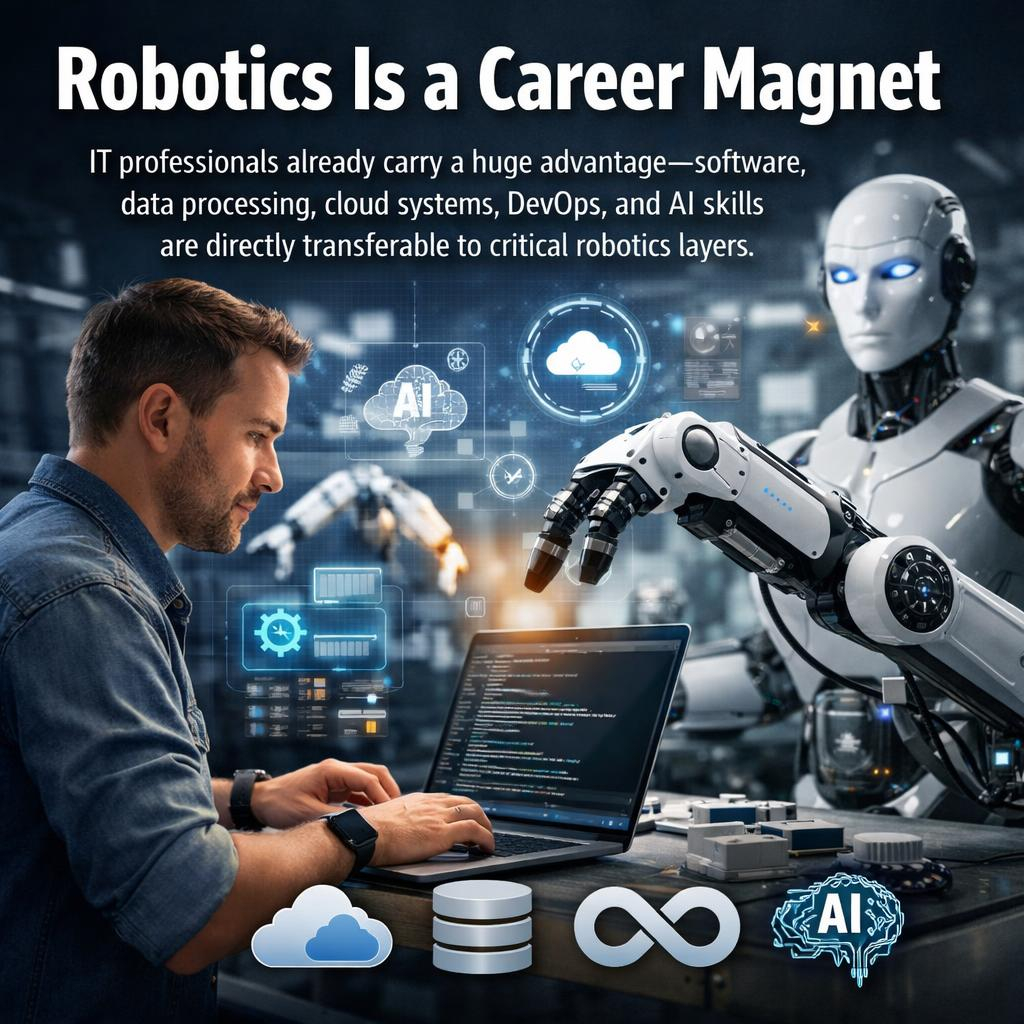
IT professionals already carry a huge advantage — software, data processing, cloud systems, DevOps, and AI skills are directly transferable to critical robotics layers.
The robotics industry is no longer a niche fad. With advances in AI, perception, mobility, and real-world deployment, humanoid and industrial robots are becoming economic mainstays. Whether it’s Tesla’s Optimus, Boston Dynamics’ Atlas, or new players like Figure AI and Agibot, robotics is rapidly creating new roles, not just replacing old ones.
This article breaks down:
- Top robotics companies to watch in 2026
- Why now is a career inflection point
- Concrete steps for IT pros to transition into robotics
Why Robotics Is a Career Magnet (Not Just a Hobby)
Robotics blends:
- AI & machine learning
- Embedded and real-time software
- Perception systems and sensor fusion
- Control, motion planning, and dynamics
- Mechatronics and hardware integration
Robotics Companies You Want on Your Radar
Here’s the expanded list of companies that are actively building robots, pushing humanoid innovations, or hiring robotics talent. These range from bold startups to industrial giants.
Humanoid & General Purpose Robotics
These companies build robots that look and act like humans — the direction many people picture when they think of “robots.”
- Tesla (Optimus) – Mass-market humanoid with heavy AI integration and vision-based autonomy.
- Boston Dynamics (Atlas, Spot, Stretch) – Pioneer of dynamic mobility. Atlas is moving toward factory deployment as a real product by 2028.
- Figure AI – Well-funded generalist humanoid development.
- Agility Robotics (Digit) – Robots performing real paid work in logistics environments.
- Apptronik (Apollo) – Modular humanoid platform with major funding and partnerships.
- 1X Technologies (NEO) – Consumer and domestic humanoid applications.
- Agibot (Yuanzheng A2) – Chinese firm producing hundreds of units and breaking walking distance records.
- Unitree Robotics – Affordable humanoid-style robots in mass distribution.
- UBTech Robotics – Humanoids for education, service, and friendly applications.
- Neura Robotics – European cognitive and collaborative robot maker.
- SoftBank Robotics (Aldebaran) – Influential in social and service robots (NAO, Pepper).
- Sanctuary AI & Others – Cognitive robotics pushing advanced interaction.
(There are dozens more globally — this is your strategic shortlist.) Forbes
Industrial & Automation Focused Players
These firms aren’t humanoids, but they are major robotics employers with huge scale:
- Universal Robots (Cobots) – Leaders in collaborative robots.
- Fanuc, ABB – Massive legacy automation firms expanding robotics arms.
- Amazon Robotics – Warehouse automation at scale.
- NVIDIA – Not a robot maker, but their platforms (Jetson, Isaac) power many AI robotics stacks.
Why 2026 Is a Unique Opportunity
Today’s robotics sector is where AI was in 2018–2019:
- Huge funding rounds
- Rapid prototyping and commercialization
- A broader shift from lab demos to deployment
- Big tech investing aggressively (Google, Meta, DeepMind on robotics research)
This means:
- Job openings are expanding
- Roles require software + hardware fluency
- Mid-career switchers can enter with the right path
Transition Roadmap for IT Pros
Here’s a practical progression that takes you from IT into robotics:
1) Foundations (0–3 months)
- Learn Python + C++
- Basics of ROS2
- Intro to robot math (linear algebra, kinematics)
2) Robotics Perception (3–6 months)
- Computer Vision (OpenCV, depth sensing)
- Sensor fusion
- Simulation environments (Gazebo, Webots)
3) Motion & Control (6–12 months)
- Kinematics / dynamics
- Motion planning libraries (MoveIt)
- Control systems
4) Systems Integration (Year 1–2)
- Real-time programming (RTOS)
- Embedded systems
- AI model deployment on robotics hardware
5) Projects + Portfolio
- Build a ROS robot stack end-to-end
- Deploy to simulated environments
- Contribute to open-source robotics projects
Career Entry Points Today
You don’t need a PhD to start:
- Robotics Software Engineer
- Perception / Computer Vision Specialist
- Simulation Engineer
- AI Integration Engineer
- Embedded Systems Developer
- Automation / Testing Engineer
Companies hiring across skills not just degrees — especially those with strong coding portfolios and open-source contributions.
Start With One Small Step Today
🔹 Pick one robotics stack (like ROS2 or NVIDIA Isaac)
🔹 Build a simple simulated robot project
🔹 Document it publicly (GitHub or blog)
This is how IT professionals turn into robotics engineers — not by waiting to be ready, but by learning in public.
Comments are closed