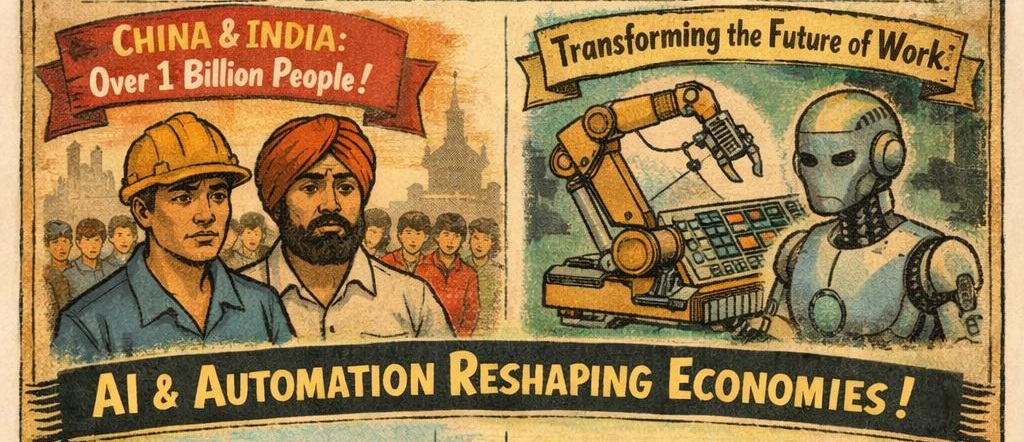
Countries with high adoption rates of AI report both high productivity enthusiasm and significant job security concerns among workers.
Let’s unpack the emerging evidence.
For decades, economic growth models were built on population size — more people meant more workers, more consumers, and (hopefully) more innovation. But today, the global economy faces a profound shift. With the rise of AI agents and automation, the old calculus of “human numbers = national strength” is being challenged.
The question now isn’t just who has more people, but who can best harness AI to generate productivity, innovation, and economic value.
The Productivity Promise and Peril of AI
AI and automation are expected to significantly reshape productivity across economies:
- Global forecasts suggest AI could displace 92 million jobs by 2030 while creating 170 million new ones, yielding a net gain of 78 million jobs — underscoring the dual nature of disruption and opportunity.
- In India, Generative AI (GenAI) alone could boost productivity by around 2.6% in organized sectors and 2.8% in unorganized sectors — a substantial lift for economic output.
- On a macro level, AI adoption is forecast to raise productivity across industries by up to 40% by 2035 in major sectors such as manufacturing and services.
These figures highlight a massive shift in how value is generated — from expanding labor forces to amplifying labor capabilities through intelligent systems.
China: Automation Powerhouse or Population Paradox?
China provides one of the clearest illustrations of this shift:
- The country leads the world in industrial robots — installing hundreds of thousands of robots annually in manufacturing, far outpacing the U.S. — boosting output, efficiency, and export competitiveness.
- AI and automation could contribute billions to China’s growth, potentially boosting its GDP’s rate of expansion by 0.2–0.3 percentage points by 2030 through task automation alone.
But here’s the paradox: China’s large workforce — once its strategic edge — is now being reshaped by machines. Automation is replacing traditional roles, especially in manufacturing and routine work. The nation’s remarkable demographic advantage is diminishing as robots and AI systems take on functions previously done by millions of workers.
This doesn’t mean China loses its position — far from it — but it must evolve its workforce toward higher-skill, AI-complementary roles if it wants to sustain growth without social disruption.
India: Opportunity or Job Squeeze?
India’s story is more complex.
On the one hand:
- India leads in AI adoption at work in the Asia-Pacific region, with high usage rates among employees compared to many peers.
- Some reports suggest AI could generate millions of new jobs in sectors like technology and customer experience by 2030.
On the other hand:
- A significant share of India’s workforce — especially in low-skill jobs — is at high risk of automation by 2030. Some estimates indicate that tens of millions of jobs, particularly in services and manufacturing, could be disrupted if the necessary reskilling doesn’t occur.
This reflects a broader structural dynamic: India’s large population remains an asset only if its workforce can transition into AI-complementary and high-value sectors. Without strategic investments in training, education, and AI infrastructure, sheer numbers may not translate into economic resilience — and could even exacerbate job displacement risks.
Other Nations
The same logic applies globally: population is no longer the sole engine of economic strength. Competitive advantage increasingly hinges on how effectively a country harnesses AI agents, automation, and innovation ecosystems.
Ask Yourself and Your Leaders:
- Does your country have a declared strategy for deploying AI agents at scale?
- Is the focus on quantity (population) or quality (AI-augmented productivity)?
- Are educational systems aligned with the jobs of tomorrow ?
Comments are closed